
Failing Veneers: When Repair Isn't Enough
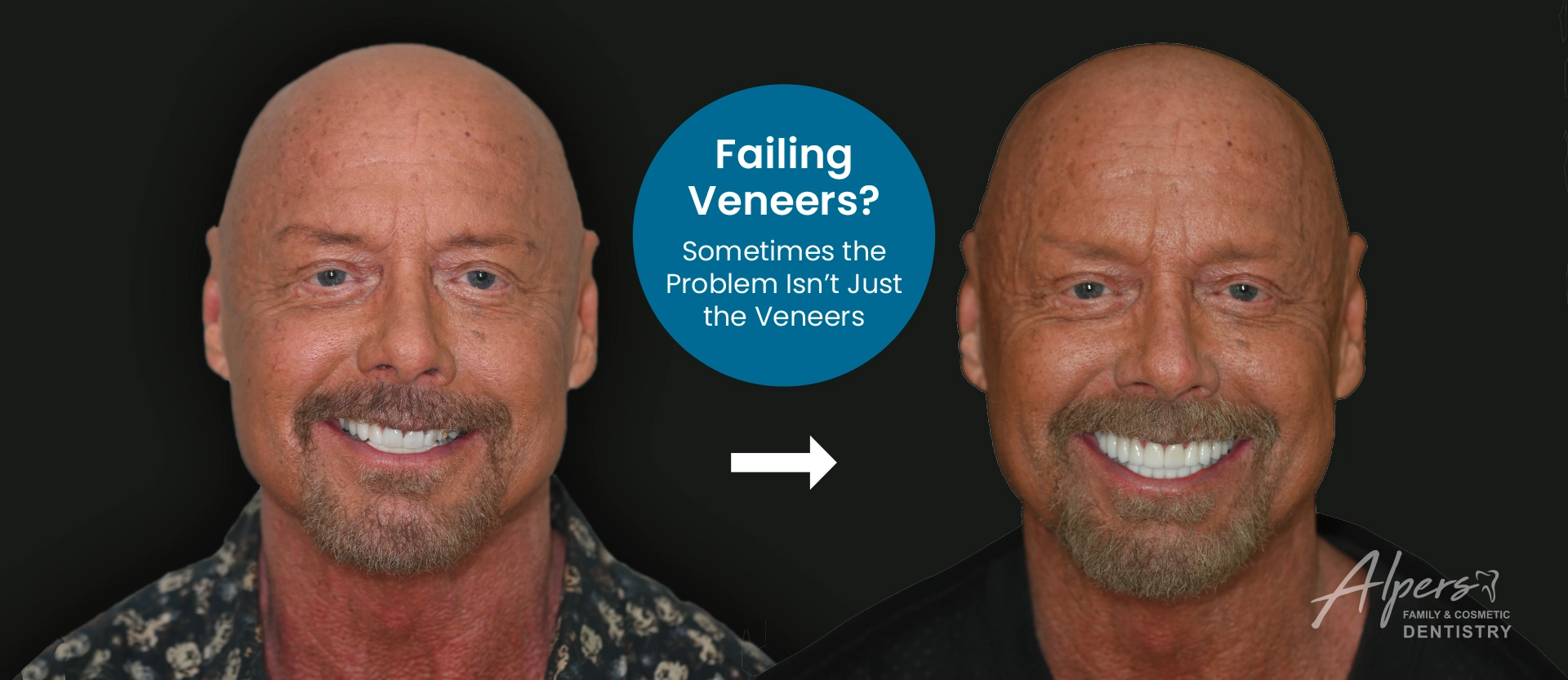
It Usually Starts with Just One Veneer
Most people don't start searching for a full mouth reconstruction.
They start searching because something feels off.
Maybe one veneer chipped. Maybe one fell off while you were eating dinner. Maybe you're noticing dark lines near your gums, discoloration that wasn't there before, or a smile that no longer looks as natural as it once did.
You might even find yourself typing questions into Google like:
Why are my veneers failing?
Can old veneers be replaced?
My veneers keep falling off. What should I do?
How long do veneers last?
Sometimes the answer really is as simple as replacing a single veneer.
But other times, failing veneers are just the first visible sign of a bigger issue that's been developing underneath for years.
At Alpers Family and Cosmetic Dentistry, one of the biggest things we help people understand is why their veneers are failing before recommending how to fix them. In many cases, the veneers aren't actually the problem. They're simply revealing changes in your teeth, bite, or past dentistry that need a more comprehensive solution.
How Do You Know If You Have Failing Veneers?
Porcelain veneers are incredibly durable, but they aren't designed to last forever.
Over time, normal wear, changes in your bite, aging dental work, or problems underneath the veneer can begin to affect how they look and function.
Some of the most common signs of failing veneers include:
- A veneer that has chipped or cracked
- Veneers that feel loose or repeatedly fall off
- Dark lines appearing around the edges
- Discoloration that wasn't there before
- Sensitivity around restored teeth
- Recurrent decay underneath a veneer
- Gum recession exposing the edge of the veneer
- A smile that suddenly looks uneven or unnatural
- Changes in the way your teeth fit together when you bite
Sometimes these changes happen gradually enough that you barely notice them until several veneers begin showing the same symptoms.
Why Do Veneers Fail?
One of the biggest misconceptions is that failing veneers automatically mean they were done poorly.
That's simply not true.
Even beautifully crafted veneers eventually reach the end of their lifespan, and your mouth continues changing long after they're placed.
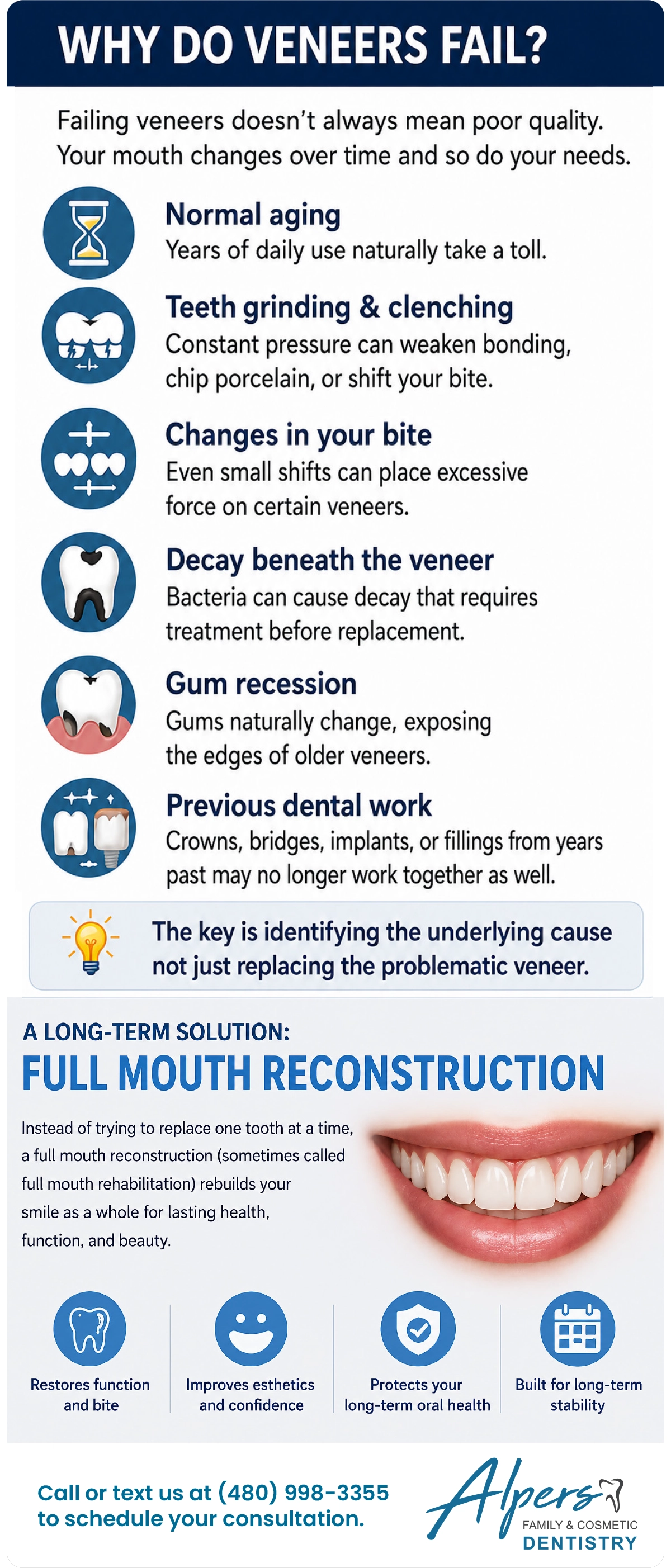
Some of the most common reasons veneers fail include:
➤ Normal aging
Like anything in dentistry, veneers experience years of daily use.
➤ Teeth grinding and clenching
Constant pressure can weaken bonding, chip porcelain, or gradually change your bite.
➤ Changes in your bite
Even small shifts in how your teeth come together can place excessive force on certain veneers.
➤ Decay beneath the veneer
If bacteria work their way under the restoration, the tooth itself may require treatment before another veneer can be placed.
➤ Gum recession
As gums naturally change over time, the edges of older veneers may become visible.
➤ Previous dental work
Many people with older veneers also have crowns, bridges, implants, or fillings that were completed over many years. Eventually, those restorations may no longer work together as well as they once did.
The important thing is identifying the underlying cause of failing veneers, instead of simply replacing the veneer that's causing today's problem.
Can Failing Veneers Be Repaired?
Sometimes.
If a single veneer has loosened because the bonding failed or there's minor damage, repairing or replacing just that restoration may be the best solution.
However, repair isn't always the long-term answer.
Replacing one veneer isn't always the best long-term solution, especially if you're noticing problems with several veneers at once. If multiple restorations are failing, your teeth have become shorter from years of grinding, your bite has changed, or there's decay developing underneath older dental work, simply replacing the veneer that's bothering you today may not solve the underlying issue.
The same is true if your smile has become a patchwork of veneers, crowns, fillings, and other restorations completed over many years. In these situations, stepping back to evaluate how everything works together often leads to a healthier, longer-lasting solution.
In these situations, replacing veneers one at a time often leads to more problems later because the underlying issue hasn't been addressed.
When Veneer Replacement Isn't Enough
One of the conversations we have most often is with someone who thinks they need a few new veneers.
After a comprehensive examination, we sometimes discover the real issue isn't the veneers at all.
Instead, we may find:
- Significant bite collapse
- Worn teeth throughout the mouth
- Older crowns nearing the end of their lifespan
- Missing teeth affecting function
- Dentistry that's no longer working
Rather than chasing one problem after another, it can make more sense to step back and rebuild the smile as a whole.
That's where a full mouth reconstruction, sometimes called a full mouth rehabilitation, becomes the better long-term solution.

What Is a Full Mouth Reconstruction?
Despite the name, a full mouth reconstruction doesn't mean every tooth needs to be replaced.
In fact, one of the biggest misconceptions is that treatment always involves removing everything and starting over.
A full mouth reconstruction is simply a customized treatment plan that restores the health, function, appearance, and longevity of your smile using the most conservative approach possible.
Depending on your needs, treatment may include:
- Replacing old veneers
- Dental crowns
- Dental implants
- Implant-supported bridges
- Implant-supported dentures
- Dental bridges
- Bite reconstruction
- Gum contouring
- Treatment for worn or damaged teeth
Every plan is different because every smile is different.
The goal isn't to perform more treatment.
The goal is to preserve as much of your healthy teeth as possible while creating a smile that functions comfortably for years to come.
A Conservative Second Opinion Can Change Everything
Many people come to our office after being told their only option is an aggressive full-arch procedure.
Sometimes they're discouraged because they feel like they're about to lose healthy teeth.
One of the first questions we ask is simple:
What healthy tooth structure can we preserve?
That philosophy often leads to treatment plans that are significantly more conservative than patients expected.
One patient came to us after being told there was essentially nothing that could be done without a much more aggressive full-arch solution.
After carefully evaluating her smile, we created a customized treatment plan that combined veneers, an implant-supported restoration, and crowns. Instead of removing healthy teeth unnecessarily, we rebuilt what was missing while preserving what was still healthy.
The result wasn't just a beautiful smile.
It was a solution that felt natural, functioned comfortably, and gave her confidence she never thought was possible.

Sometimes the Answer Is Creating Space, Not Just Replacing Teeth
One of the more advanced aspects of full mouth reconstruction involves rebuilding the bite itself, not just the failing veneers. Many people want longer, more youthful-looking front teeth, but there simply isn't enough room to create them.
Rather than forcing restorations into a space that doesn't exist, we can sometimes carefully restore the height of the back teeth to open the bite and create the room needed for a healthier, more natural smile. This approach can improve comfort while chewing, bite balance, long-term durability of restorations, and overall smile proportions.
Some people even notice subtle improvements in their facial profile because restoring the proper vertical dimension provides better support for the lower face.
You may have heard this described as a "non-surgical facelift."
While our goal is always restoring function first, many patients appreciate that looking younger can be a welcome bonus.

Looking Beyond the Veneers
If your veneers are starting to fail, it's easy to focus on the one that's chipped, loose, or discolored.
But sometimes that visible problem is pointing to something larger.
Understanding why your veneers are failing is the first step toward choosing a solution that lasts, whether that's replacing a single veneer or planning a comprehensive full mouth reconstruction.
At Alpers Dentistry, our goal is never to recommend more treatment than you need. It's to understand the complete picture, preserve as much of your natural teeth as possible, and help you enjoy a smile that looks beautiful, feels comfortable, and serves you well for years to come.
Schedule Your Consultation Today
If your veneers are starting to chip, loosen, discolor, or simply don't look the way they used to, you don't have to settle for another temporary fix. Understanding why your veneers are failing is the first step toward finding a solution that truly lasts.
Whether you need to replace a single veneer or would benefit from a more comprehensive treatment plan, we're here to help you explore your options without recommending more treatment than you need.
Schedule a consultation with our team to receive a thorough evaluation, discuss your goals, and learn what it would take to restore a smile that looks natural, feels comfortable, and gives you the confidence to smile again.
Frequently Asked Questions About Failing Veneers:

Ready to schedule an appointment?
We look forward to meeting you! To schedule, call or text or book online.

Locations We Serve
Our Scottsdale dental office serves the following areas:

Scottsdale
Paradise Valley
Fountain Hills
Phoenix
Tempe
We also serve these specific communities in Scottsdale AZ:
- Old Town Scottsdale
- Scottsdale Fashion Square
- Camelback Country Estates
- Mountain Shadows
- Arcadia
- Arcadia Lite
- Biltmore Area
- Papago Parkway
- Central Scottsdale
- Gainey Ranch
- McCormick Ranch
- Kierland Commons
- Sweetwater Ranch
- Scottsdale Ranch
- Cactus Corridor
- McDowell Mountain Ranch