
Can a Cavity Heal on Its Own? Sometimes, If You Catch It Early Enough
If you've been told you have “the start of a cavity,” you might assume there's only one possible ending: eventually, you'll need a filling.
That's not always true.
Early tooth decay can sometimes be stopped and remineralized before a physical hole forms in the tooth. But once decay has broken through the surface and created a cavity, that missing tooth structure cannot grow back on its own.
That distinction matters.
Because there can be a window between a completely healthy tooth and one that needs to be drilled and filled. And today, we have more preventive and non-invasive ways to take advantage of that window.
At Alpers Family and Cosmetic Dentistry in Scottsdale, that's a big part of how we think about preventive care: find changes earlier, understand why they're happening, and intervene as conservatively as we can.
The Short Answer: Can a Cavity Heal on Its Own?
It depends on what you mean by a “cavity.”
If there's already a hole in your tooth, no. Enamel can't regenerate the missing portion of the tooth on its own. Depending on how much damage has occurred, the tooth will typically need restorative treatment.
If you're talking about very early tooth decay before the enamel surface has cavitated, that's different.
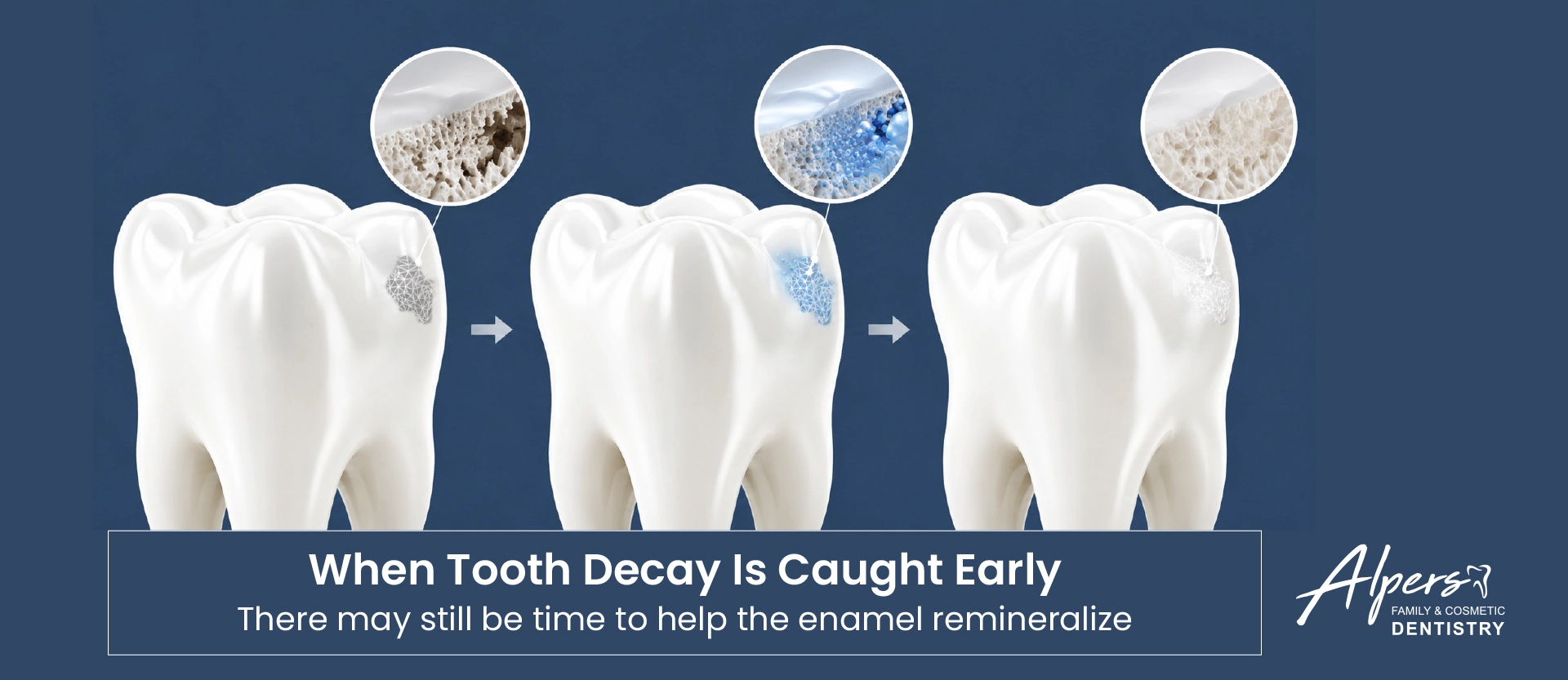
At this stage, the enamel is losing minerals, a process called demineralization, but the surface of the tooth is still intact. Under the right conditions, minerals can be deposited back into the weakened enamel through remineralization.
The American Dental Association describes tooth decay as a dynamic process involving cycles of demineralization and remineralization. Whether decay progresses, stops, or reverses depends on the balance between factors such as bacteria, sugar exposure, saliva, fluoride, and oral hygiene.
So the key question isn't simply, “Do I have a cavity?”
It's:
“How far has the decay progressed?”
That determines what we may still be able to do about it.
Tooth Decay at a Glance
Healthy enamel: No active decay is present.
Early or noncavitated decay: Minerals have been lost from the enamel, but the tooth's surface is still intact. Depending on the lesion and your risk factors, it may be possible to arrest or remineralize the area without drilling.
Cavitated decay: The tooth's structure has physically broken down and a hole has formed. Remineralization cannot replace the missing tooth structure.
More advanced decay: Decay can progress farther into the tooth toward the pulp, potentially causing sensitivity, pain, infection, or the need for more extensive treatment.
This is why two people who both say, “My dentist found a cavity,” may need very different treatment.
Can Early-Stage Tooth Decay Be Reversed?
Yes, some early-stage tooth decay can be arrested or remineralized while the tooth's surface is still intact.
Your mouth is constantly going through a tug-of-war between demineralization and remineralization.
Bacteria in dental plaque metabolize carbohydrates and produce acids. Those acids can pull minerals from enamel. Saliva helps counteract that process by buffering acids and supplying minerals, while fluoride promotes remineralization and makes the tooth surface more resistant to future acid attacks.
If mineral loss consistently wins, decay progresses.
If we can change that balance early enough, the lesion may stop progressing and potentially remineralize.
That's the window we're looking for.
Can a Dentist Reverse a Cavity Without Drilling?
Sometimes, if the decay is still noncavitated.
Dentistry isn't simply divided into “healthy tooth” and “filling.”
For early lesions, dentists may use strategies such as fluoride, changes to home care and diet, sealants in appropriate areas, risk-factor management, monitoring, and other nonrestorative treatments. The ADA has clinical guidance specifically addressing nonrestorative management of both noncavitated and certain cavitated caries lesions.
And we now have another option in our office for certain early lesions:
Curodont.
We're pretty excited about it.
What Is Curodont, and How Is It Different?
Curodont is one of the newer tools we've added to our preventive approach at Alpers Dentistry.
It uses a self-assembling peptide known as P11-4.
Rather than drilling away tooth structure and placing a restoration, the treatment is intended for appropriately selected early, noncavitated caries lesions.
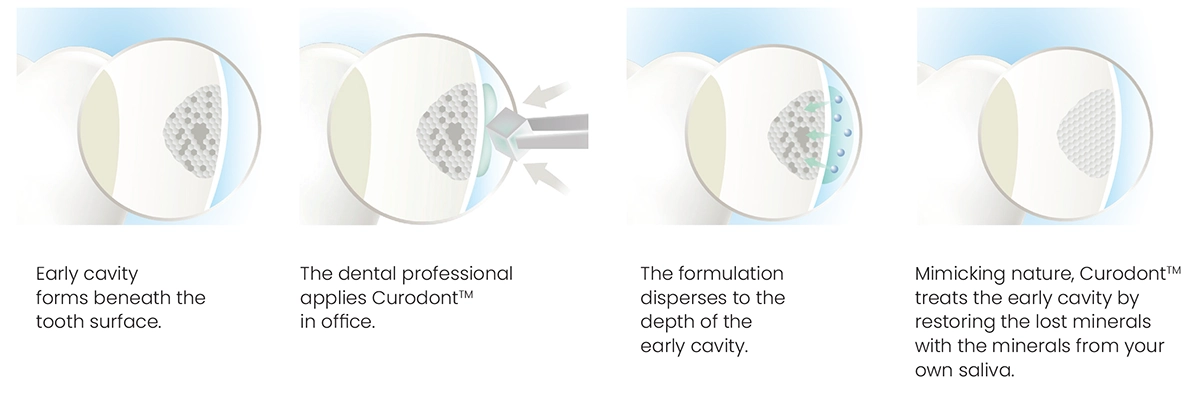
The peptide diffuses into the early lesion and self-assembles into a matrix that supports mineral formation within the demineralized enamel.
In much simpler terms, we often explain it this way:
We're trying to give the tooth an opportunity to rebuild mineral before the damage becomes a hole that we have to repair.
Clinical research on P11-4 has found promising results for remineralization and arrest of initial caries lesions. A 2023 systematic review and meta-analysis published in the Journal of the American Dental Association concluded that Curodont Repair likely has clinically important effects on caries arrest and reducing lesion size, while also noting limitations in the available studies and the need for longer-term research.
A 2022 systematic review likewise found evidence favoring P11-4 for remineralization of early enamel lesions, while calling for additional long-term research.
That's the kind of evidence we want to see with a newer preventive treatment: promising enough to give us another useful option, without pretending it's appropriate for every cavity.
What Does Curodont Treatment Involve?
For you, the treatment itself is pretty uneventful.
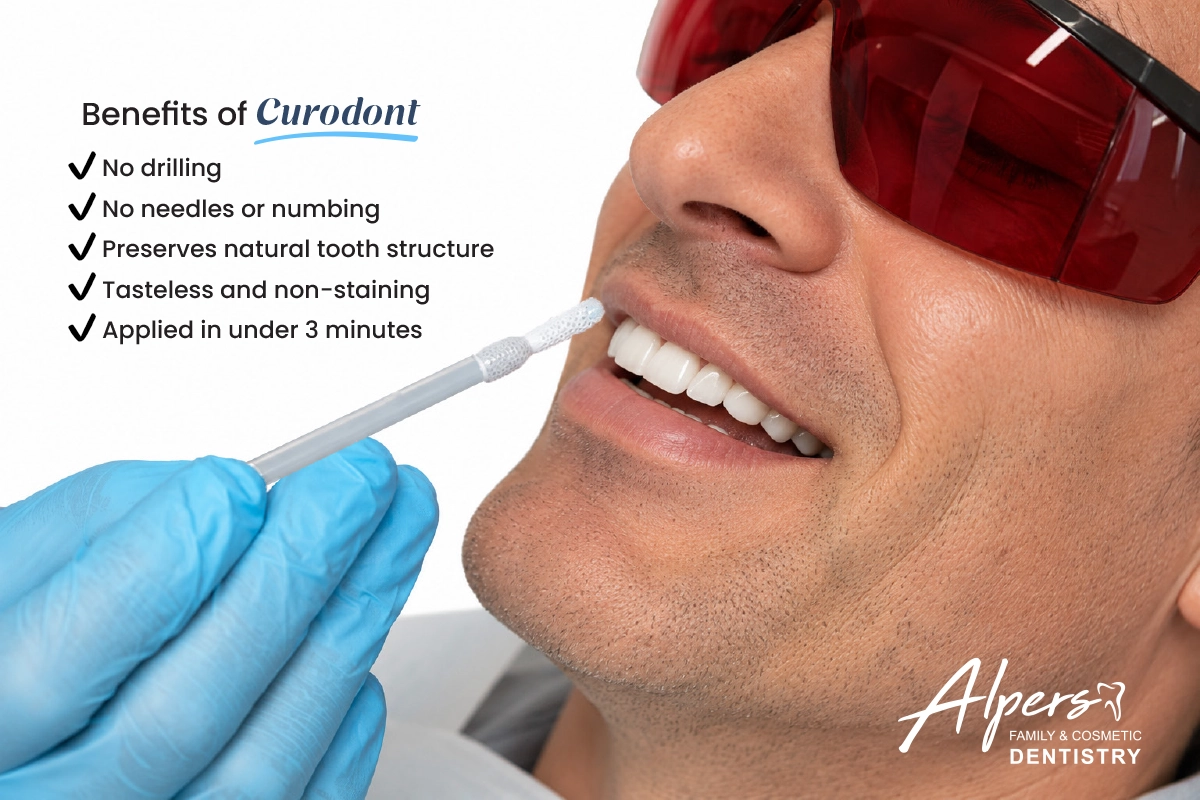
There's no drilling and no filling when Curodont is being used appropriately on an early noncavitated lesion.
We first have to determine that the area is actually a candidate. If it is, the tooth is prepared according to the treatment protocol and Curodont is applied to the area.
In many cases, we can incorporate this into a hygiene visit rather than having you return for a traditional restorative appointment.
Then we continue to monitor the tooth.
That's an important point: Curodont doesn't replace good home care or future dental exams.
We're still interested in why the decay developed in the first place and whether your overall risk for developing additional cavities has changed.
Curodont vs. a Filling: What's the Difference?
The difference largely comes down to when we find the decay.
If we catch an appropriate lesion while the tooth surface is still intact, a noninvasive approach such as Curodont may be an option.
If decay has progressed to the point where tooth structure has physically broken down, we can't simply remineralize the missing portion back into existence.
At that point, a filling may be the more appropriate treatment.
That's why early detection has real value.
It's not just about finding a “smaller cavity.”
Sometimes it's the difference between helping preserve the existing tooth structure and having to remove and replace damaged structure.
Why Don't You Just “Watch” an Early Cavity?
Sometimes we do.
Monitoring can absolutely be the right decision for certain areas.
But “watching” shouldn't mean ignoring what's happening until the tooth needs a filling.
If we see early mineral loss, we want to understand things like:
Is the lesion active? Is it progressing? Where is it located? What's your overall cavity risk? Are you getting repeated acid exposure? Is plaque accumulating in that area? Are you getting enough fluoride? Has your saliva changed? Are there other early lesions we should be thinking about too?
Depending on those answers, the right plan might be improved home care, dietary changes, fluoride, a sealant, Curodont, closer monitoring, or restorative treatment.
The goal isn't to avoid fillings at all costs.
The goal is to avoid removing healthy tooth structure when we have a predictable opportunity to preserve it.
How Can You Help an Early Cavity Heal at Home?
This is where we want to be very clear, because there's a lot of questionable advice online about “healing cavities naturally.”
You cannot regrow a piece of tooth that's already gone.
But if a dentist determines that you have early, noncavitated decay, your daily habits can play an important role in helping stop the disease process and supporting remineralization.
Here are some at-home recommendations that we generally want you to focus on:
- Brush twice a day with fluoride toothpaste. Fluoride supports remineralization and helps make enamel more resistant to acid.
- Clean between your teeth every day. Decay frequently develops in areas your toothbrush doesn't reach well.
- Reduce how frequently you expose your teeth to sugar and fermentable carbohydrates. It's not only the total amount that matters. Repeated snacking or sipping can create repeated acid attacks throughout the day.
- Drink water and support healthy saliva flow. Saliva plays an important role in neutralizing acids and remineralization.
- Don't assume an area is getting better just because it doesn't hurt. Early decay frequently causes no pain.
- Have the area evaluated and monitored by a dentist. You need to know whether you're dealing with early demineralization or a cavity that has already progressed beyond the point where remineralization is realistic.
And that's the limitation of trying to “heal a cavity at home.”
You can't reliably determine how deep the decay is by looking at or feeling the tooth yourself.
The first step isn't buying a remineralizing product.
It's finding out what stage you're actually dealing with.
How Do You Know If a Cavity Is Getting Worse?
Sometimes you don't.
That's one of the frustrating things about tooth decay.
A cavity can progress without hurting, particularly in its earlier stages. Waiting until you feel something isn't a reliable way to decide when treatment is necessary.
As decay becomes more advanced, you might notice things such as:
- increasing sensitivity to cold, heat, or sweets
- pain when biting
- spontaneous toothache
- a visible dark area or hole
- food repeatedly getting caught in the same place
- a rough or broken area you can feel with your tongue
But symptoms don't tell us the whole story.
A tooth can have meaningful decay without any of these warning signs.
That's why we would much rather find an early change during an exam than meet you for the first time because the tooth suddenly hurts.
Why Did I Get a Cavity Even Though I Brush My Teeth?
This comes up all the time.
Brushing matters enormously, but tooth decay is multifactorial.
Your risk can also be influenced by the bacteria and biofilm in your mouth, how frequently you consume sugar and fermentable carbohydrates, fluoride exposure, saliva quantity and composition, dry mouth, tooth anatomy, and other individual factors.
That's why our preventive approach goes beyond saying, “Brush better.”
If you're suddenly developing cavities after years without them, or you keep getting decay despite feeling like you're doing everything right, we want to understand why.
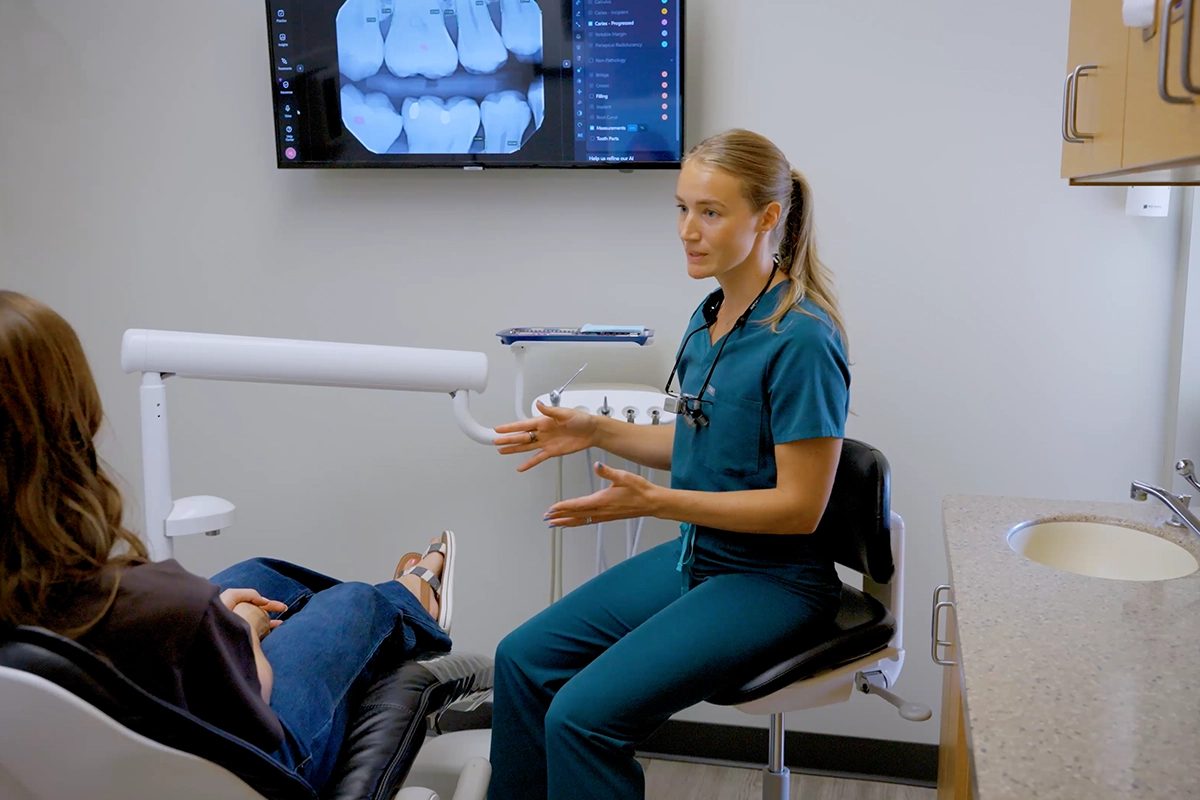
At Alpers Dentistry, that can include a more comprehensive evaluation of your oral health and, when appropriate, saliva testing to help us better understand the environment contributing to disease.
Because treating one early lesion is helpful.
Finding out why you're developing them in the first place is even better.
What Should You Do If You Think You Have an Early Cavity?
Don't try to determine at home whether it's “reversible.”
And don't wait for it to hurt.
The most useful next step is to have the tooth evaluated while conservative options may still be available.
Until you're seen, keep brushing twice daily with fluoride toothpaste, clean between your teeth, limit frequent sugar exposure, and drink water regularly.
Then we'll determine what you're actually dealing with.
It may be an area that simply needs monitoring.
It may need additional preventive support.
It may be an early lesion that could benefit from Curodont.
Or it may already need a filling.
The important part is finding out before you're forced into the last option because the decay has progressed too far.
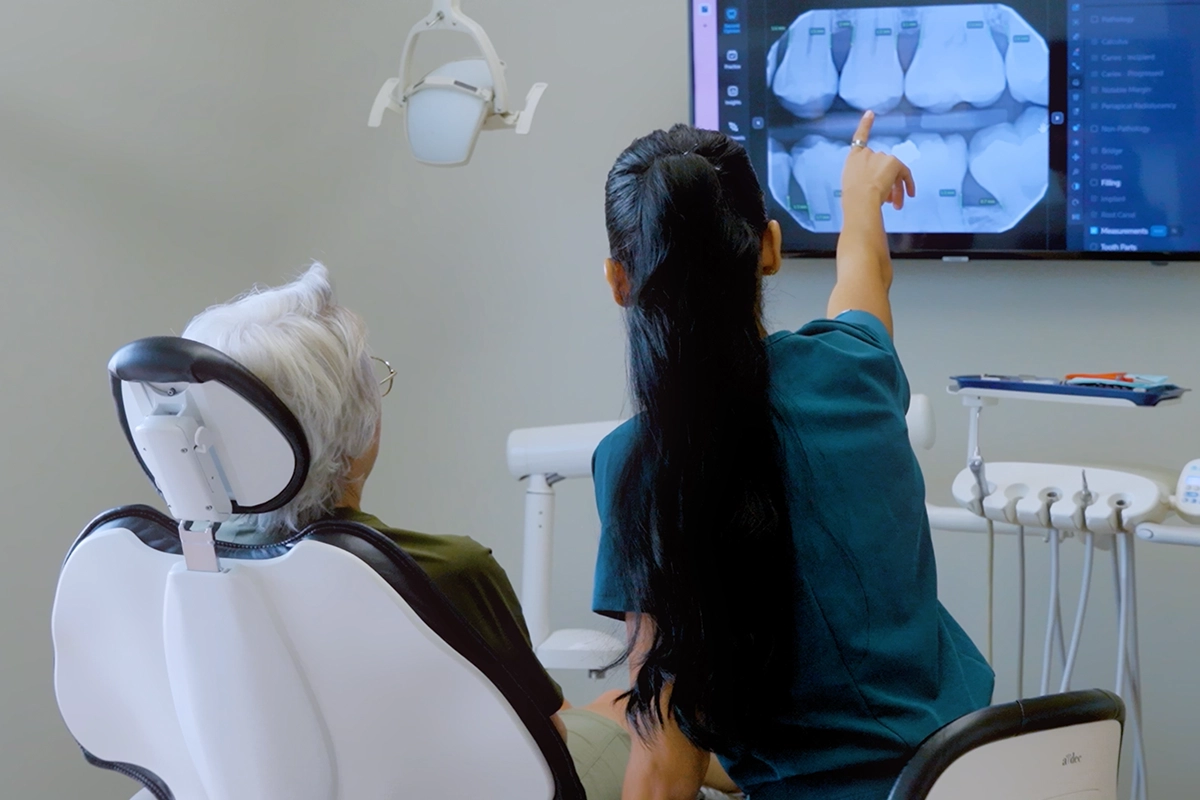
Signs It's Time to Schedule a Dental Exam
You don't need to wait for symptoms, but we'd especially recommend having a tooth evaluated if you've noticed a new white, brown, or dark area; increasing sensitivity; pain when chewing; a rough spot or visible hole; food consistently getting trapped in one area; or a tooth that has started hurting without an obvious reason.
And if another dentist has told you that you have an area of “early decay” or a cavity they're watching, it's reasonable to ask:
✔️ Is the surface still intact?
✔️ Is the lesion active?
✔️ Is remineralization still possible?
✔️ Are there nonrestorative treatments we can use now?
Those questions get you much closer to understanding your actual options than simply asking, “Do I need a filling?”
The Bigger Idea: The Best Filling Is the One You Never Need
This is where Curodont fits into a much bigger philosophy for us.
At Alpers Family and Cosmetic Dentistry, we don't consider preventive dentistry to be something that happens only during your cleaning.
We want to identify small changes while we still have small solutions.
That can mean digital imaging and careful exams to identify decay earlier. It can mean fluoride, saliva testing, changes to home care, or looking more closely at why your cavity risk has changed. And for the right early lesions, it can now include Curodont.
Our goal isn't to promise that we'll reverse every cavity.
We can't.
It's to identify the ones that haven't become irreversible yet and give you the best opportunity we can to keep them that way.
Because once a tooth has been drilled and restored, that tooth enters a restorative cycle. Fillings can eventually require replacement, and larger restorations may become necessary over a lifetime.
When we can safely preserve your original enamel instead, that's worth doing.
Find Out Whether Your Tooth Can Still Be Treated Without a Filling
If you've been told you have an early cavity, or you're wondering whether an area can still be remineralized, earlier is the time we'd rather see you.
Not because every suspicious spot needs treatment.
Quite the opposite.
The sooner we understand what's happening, the more options we may have to preserve your natural tooth.
At Alpers Family and Cosmetic Dentistry in Scottsdale, Dr. Alpers and our team take a preventive, conservative approach to tooth decay. We'll evaluate the area, show you what we're seeing, assess your overall cavity risk, and talk through whether monitoring, fluoride, Curodont, or restorative treatment makes the most sense.
The question isn't just whether you have a cavity. It's whether we still have an opportunity to stop it before it becomes one that needs to be filled.
Call or text (480) 998-3355 to schedule an appointment.
Frequently Asked Questions About Reversing Cavities

Ready to schedule an appointment?
We look forward to meeting you! To schedule, call or text or book online.

Locations We Serve
Our Scottsdale dental office serves the following areas:

Scottsdale
Paradise Valley
Fountain Hills
Phoenix
Tempe
We also serve these specific communities in Scottsdale AZ:
- Old Town Scottsdale
- Scottsdale Fashion Square
- Camelback Country Estates
- Mountain Shadows
- Arcadia
- Arcadia Lite
- Biltmore Area
- Papago Parkway
- Central Scottsdale
- Gainey Ranch
- McCormick Ranch
- Kierland Commons
- Sweetwater Ranch
- Scottsdale Ranch
- Cactus Corridor
- McDowell Mountain Ranch